Tuesday, August 25, 2015

A bone to pick with Lizzie

At the Atlanta History Center in Buckhead, just outside the heart of Atlanta, lies a sweetheart pin made from a most unusual item. Abigail Arline of Albany, Georgia, was working in a hospital as a nurse during the Civil War. A wounded Confederate soldier was admitted and had to have his leg amputated. After the surgery, the soldier took a piece of his leg that had been cut from his body and inscribed his name on the bone to give to his sweetheart, a girl named Lizzie. The soldier ended up dying of his wounds so nurse Abigail was not able to pass on the pin because no one knew the name of the soldier or the full name of the recipient. It exists on display at the history center.


Cheré Dastugue Coen is an international travel writer and the author of “Forest Hill, Louisiana: A Bloom Town History,” “Haunted Lafayette, Louisiana” and “Exploring Cajun Country: A Historic Guide to Acadiana” and co-author of “Magic’s in the Bag: Creating Spellbinding Gris Gris Bags and Sachets.” She also writes Louisiana romances under the pen name of Cherie Claire, “A Cajun Dream” and “The Letter.” Write her at cherecoen@gmail.com.

Wednesday, August 19, 2015

Memorial bridge should not be Butt of jokes

Major Butt
Kids come by the busload to explore the historic Augusta Canal in Augusta, Georgia, and enjoy a good laugh when they do.
The waterway was constructed in 1845 by Augusta native Henry H. Cumming, who wanted to see the Southern city become “the Lowell of the South,” a hub of textile manufacturing. The canal was built as a source of power and transportation, drawing textile factories to the area that indeed encouraged the city’s growth.
Today, the canal is preserved for historic education and residents and visitors utilize the waterway for boating, hiking and biking.
Boat ride down the Augusta Canal
            But that’s not makes those children laugh when they take a boat ride down the canal. It’s the bridge locals call the “Butt Bridge.”
            Although not really a laughing matter, the Butt Memorial Bridge over the canal at 15th Street stands as a memorial to Major Archibald Willingham Butt, who went down with the RMS Titanic on the morning of April 15, 1912. Pres. William Howard Taft was a friend of the Augusta native and dedicated the 1914 bridge, the first structure created to memorialize the Titanic disaster.
            The Butt Bridge almost disappeared when 15th Street was rerouted for a new thoroughfare. Locals stopped planners from demolishing the bridge, raising money by hosting concerts called the Butt Jam in 1994 and 1995. The unofficial slogan of the time was “Save Our Butt.” Later, an act of Congress was passed, along with help by actors Kate Winslet and Leonardo DiCaprio, stars of the blockbuster film “Titanic,” and the fate of the Butt was settled.
            It’s quite an impressive Butt, with lions on each end and majestic eagles stretching their wings on golden globes atop pillars sporting lights.

Cheré Dastugue Coen is an international travel writer and the author of “Forest Hill, Louisiana: A Bloom Town History,” “Haunted Lafayette, Louisiana” and “Exploring Cajun Country: A Historic Guide to Acadiana” and co-author of “Magic’s in the Bag: Creating Spellbinding Gris Gris Bags and Sachets.” She also writes Louisiana romances under the pen name of Cherie Claire, “A Cajun Dream” and “The Letter.” Write her at cherecoen@gmail.com.


Monday, August 10, 2015

My cocktail ancestor: I may not be related to the creator of the Ramos Gin Fizz but I'm claiming it!

I love a good mystery so when one landed in my lap — a genealogy mystery at that — I was up for the task. Add a cocktail to the mix and you’re talking good times.
It all started with my grandmother’s family, who took in a young woman when she lost her parents in the late 19th century. Leontine McCarty’s father served in some capacity in the Civil War for he left behind letters he wrote to his wife, Mary Howard, a native of Baltimore. On what side Joseph McCarty served is anyone’s guess; I have yet to find out. Joseph McCarty died right after the war, in New Orleans, and Mary went to work as a steward for the quarantine station at the mouth of the Mississippi. She wasn’t happy there (who would be?) and later remarried, then died, leaving Leontine McCarty alone. That’s where my grandmother’s family came in.
            Genealogy is big part research, many parts guessing game. Leontine went to work for the Ramos family and a cousin claimed this was for Henry C. Ramos, the creator of the Ramos Gin Fizz cocktail. All my genealogy sources show she rented and was head of the boardinghouse owned by Henry’s brother, William, then purchased the building at 836 N. Rampart Street after William Ramos’s death in New Orleans. In some documents, she’s listed as being Mrs. L. Savant but I’ve never found a Mr. Savant connected to Leontine.
            My cousin also claimed the building had three servant quarters, two apartments and a downstairs kitchen “about a block long.” “We used to skate up and down that long yard — the food was sent up from the kitchen,” she related. “They had I think called the dump elevator opened in this big lovely dining room.”
Leontine McCarty is center
            Dump elevator?
            So how this lady is related to the Ramos, I really have no idea. I do know she’s descended from the highfalutin McCarty family of New Orleans, which includes plantation owners, a former mayor and the infamous Delphine McCarty LaLaurie, who tortured slaves in what is now a haunted house (once owned by Nicholas Cage) and the subject of a recent “American Horror Story” season. Leontine, however, never associated with those folks because she’s descended from a liaison between a white McCarty and his black mistress.
What’s cool is her association with Henry C. Ramos, however that may be, a man who created an amazing drink created from gin, egg whites, cream, lemon and lime juices, orange flower water and soda water that must be shaken at least six minutes. At least! He invented this time-intensive concoction in 1888 at his bar, the Imperial Cabinet Saloon on Gravier Street in New Orleans. At one time Ramos had bartenders lined up to shake his popular cocktail, passing along the shakers when arms got tired. And don’t even think to stir it!

This summer, the Bourbon O Bar in the Bourbon Orleans Hotel in the middle of the French Quarter of New Orleans brought back the frothy, refreshing Ramos Gin Fizz, the perfect anecdote to summer. They have installed a shaking machine that saves their bartenders from quitting, so visitors can ask for the perfect Ramos Gin Gizz shaken 12 minutes for optimal effect, as per Henry’s instructions, and sign the book reserved for those willing to wait for the ideal drink. When I received my frothy, delicious drink — and yes, my name is in the book — I took my photo with Henry C. Ramos, a man who kinda sort is related. Maybe?


Courtesy of the Bourbon Orleans
Here’s the cocktail recipe, thanks to the Bourbon Orleans Hotel.

Ramos Gin Fizz
1 1/2 ounces gin

1 tablespoon simple syrup (1:1)

1/2 ounce fresh lemon juice

1/2 ounce fresh lime juice

1 fresh egg white 

1 ounce heavy cream

3 drops orange flower water

1 ounce club soda
Chilled
 tools: shaker, strainer

Glass: highball
Garnish: Orange peel

Direction: Combine the first six ingredients in a shaker without ice and shake vigorously to combine. Add ice to the shaker and shake again for at least 6 to 12 minutes. Strain into a glass, top with club soda and the orange flower water and stir.

Cheré Coen is an award-winning travel writer specializing in the Deep South. She is the author of "Forest Hill, Louisiana: A Bloom Town History," "Exploring Cajun Country: A Historic Guide to Acadiana" and "Haunted Lafayette, Louisiana" and co-author of "Magic's in the Bag: Creating Spellbinding Gris Gris Bags and Sachets." She also writes Louisiana romances under Cherie Claire, including "A Cajun Dream" and "The Letter." Write her at cherecoen@gmail.com.

Wednesday, August 5, 2015

Finding peace and comfort at the edge of Texas

            Life throws some awfully weird curve balls. While I was on the road this past month, I reflected on how lucky I was not to have a disaster starring me in the face this summer. If you think that is weird, let me explain. Ever since the turn of the 21st century, there have been plenty of tragedies in my little corner of the South — Hurricanes Katrina, Rita, Gustav and Ike, one of which was the costliest disaster in U.S. history and the destruction of my home town of New Orleans and my mother’s home town of Biloxi; the Deepwater Horizon oil spill, the costliest manmade disaster; and the tragic abduction and murder of a darling young girl who was a friend of my son’s.
            Then July 23 arrived with the news that a lone gunman had entered a movie theater in my town of Lafayette, Louisiana, and killed someone I knew.
            Needless to say, I entered Port Arthur, Texas, feeling as low as a snake’s belly. I was there to write a story about kayaking at Sea Rim Park on the Texas coast, arriving around sunset to my comfy TownePlace Suites motel for the night. The motel people were welcoming and nice, the room cozy, a bag of goodies left by the tourism folks but my heart was heavy. I knew I should drive around and check out things wearing my travel writer hat, but a cloud hung over me like a shroud.
            Shuffling through the tourism pamphlets, I saw there was a “Port Arthur Faith Trail,”featuring three massive statues honoring religions. I grabbed my camera and headed out the door, not sure what I’d find or why but the light was good for photos, I told myself.
            The first stop on the Faith Trail was the Shrine of Our Lady of Guadalupe, a 17-foot bronze statue of Mary next to the Our Lady of Guadalupe Catholic Church. The impressive statue was created by artist Miguel Angel Macias from Mexico City and Texas sculptor Douglas Clark and is set upon rocks that church parishioners brought from Mount Tepeyac, Mexico City, where Juan Diego experienced a vision of the Virgin Mary. A 7-foot bronze statue of St. Juan Diego, sculpted by the same artists, sits at the bottom of the shrine, a penitent man gazing up at Mary with his hands crossed.
            I’m not Catholic, and didn’t grow up with religious icons, but the image of Mary’s warm eyes brought me peace on a day when it was desperately needed.
            Literally about a mile down Ninth Street is the Vietnamese Martyr’s Catholic Church & Queen of Peace Shrine and Gardens, where another larger-than-life statue of Mary exists, this time in Hoa-Binh or an area of peace. According to CatholicPlaces.org, the 20-foot-tall Mary and shrine was created "in gratitude for their escape from Asia and the city which welcomed them." 
I visited this statue the following day, after my trip to the coast with Darragh Castillo of the Port Arthur Convention and Visitor’s Bureau, a delightful woman who made me laugh and forget my troubles. So I was in a better mood. This vision of Mary with her heart aflame with love appeared to wave at me and smile, giving me hope that everything would be alright.
            Both churches allow visitation to their statues at no charge but daylight hours apply.
            In the center of town lies the Buu Mon Buddhist temple, which moved to Port Arthur from Orange, Texas, in 1986. The Buddhists remodeled the former Vietnamese Catholic church, building stupa where there was once a steeple, and installing a 7-foot-tall bronze Buddha seated in front of a fresco mural of a Bodhi tree on a river’s shore. The Port Arthur Buu Mon Buddhist Temple is known worldwide for its tropical and hardy lotuses and water lilies, along with other species in its garden areas around the temple. They offer an annual Lotus Garden Tour, but are available through the rest of the growing season for private tours. Call ahead for an appointment.
Sea Rim Park boardwalk
            I had been to the Buddhist Temple before, but the giant Buddha was a new addition. Again, feelings of peace and comfort, surrounded by a beautiful garden, nature at its best.
            Ironically, the marshes at Sea Rim Park was too low for kayaking so I didn’t get my paddle. But we got to walk the park’s boardwalks spotting birds and other critters — even getting drenched in an afternoon thunderstorm — then enjoyed one of the best Vietnamese meals I’ve ever had at Uyen’s. Driving home to Louisiana along the coast, my heart felt much lighter.
            Port Arthur, by the way, lies at the southeastern tip of Texas, below Beaumont and just north of the Gulf of Mexico. For more information on the Faith Trail and other attractions in the area, visit the Port Arthur Conventions and Visitor’s Bureau.


Cheré Coen is an award-winning travel writer specializing in the Deep South. She is the author of "Forest Hill, Louisiana: A Bloom Town History," "Exploring Cajun Country: A Historic Guide to Acadiana" and "Haunted Lafayette, Louisiana" and co-author of "Magic's in the Bag: Creating Spellbinding Gris Gris Bags and Sachets." She also writes Louisiana romances under Cherie Claire, including "A Cajun Dream" and "The Letter." Write her at cherecoen@gmail.com.

Tuesday, August 4, 2015

Golden Triangle of Texas an unusual collection of fun

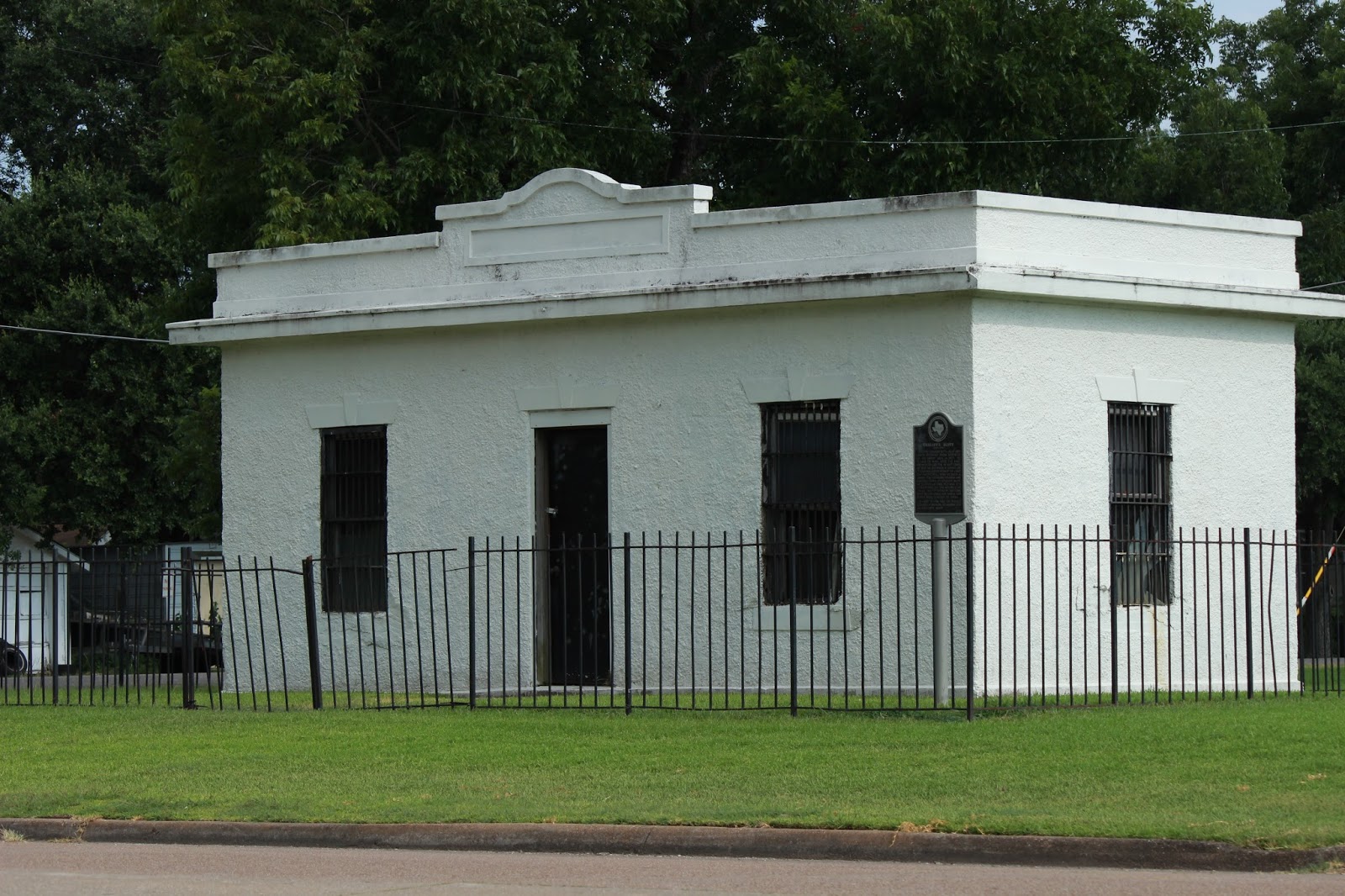
Groves Jail
          The southeastern-most point of Texas butts heads with Louisiana and the Gulf of Mexico, while providing for water access into the state’s interior. They call this area consisting of the cities of Beaumont, Port Arthur and Orange the “Golden Triangle,” for it was here that oil was discovered at the famous Spindletop outside of Beaumont in 1901. Other towns within the Golden Triangle are Groves, Port Neches and Nederland.
Like many other spots in Texas, there’s plenty of weird to go around here, and I always seem to find them when asking simple questions, such as “How did the small town of Groves get its name?” My tourism contact informed me it was due to the pecan trees growing there, which, ironically, are not the income producers they once where but the town still hosts an annual Pecan Festival every fall. The thousands of pecan trees were planted in this small Texas town by the Griffing Brothers Nursery and when the land was subdivided, the land company called it “Pecan Grove.” Here’s where the weird comes in, the s was later added “after development representative and pioneer Port Arthurian Asa Groves,” according to Wikipedia.
Beausoleil House interior
How’s that for irony.
Over in Port Neches (the latter sounds like Tenacious), there’s a tiny building on Grigsby Street with a historical marker out front. This two-cell jail was built during World War I to operate as a branch of the county jail, constructed for the large price of $2,218. If you’d get a good look at this building, that seems high even for today’s standards. What’s even more surprising is its size, appearing like something out of a western comedy with the drunk hanging his hands through the railing and promising to be good.
Across the street in the RiverFrontPark overlooking the Neches River lies the Beausoleil House, or La Maison Beausoleil, an authentic Cajun home (and a fabulous example of early Cajun craftsmanship) built around 1810. The house originated in St. Martin Parish, Louisiana, but was donated to the Les Acadiens du Texas, “a non-profit organization dedicated to the preservation of the culture and language of the Acadian people,” and moved here via by barge. The house is open from 1 p.m. to 5 p.m. on weekends or by special arrangements.
One other great aspect of Port Neches’ RiverFront Park is Tugboat Island, a playground designed by children, built by volunteers, funded by donations and ADA accessible. This baby is huge and wonderfully creative, supposedly the third largest playground of its type in the nation and one sure to make kids squeal with glee.
Beausoleil House
So in the Golden Triangle of Texas, you can visit one of the largest playgrounds in the country next to the one of the smallest jails, enjoy a Pecan Festival in Groves named for trees no longer there but also a person who happened to be named Groves and a historic home that arrived by barge.

Next up on the Weird South blog, we look at the three giant religious monuments in Port Arthur, Texas. You won't want to miss this.

Cheré Coen is an award-winning travel writer specializing in the Deep South. She is the author of "Forest Hill, Louisiana: A Bloom Town History," "Exploring Cajun Country: A Historic Guide to Acadiana" and "Haunted Lafayette, Louisiana" and co-author of "Magic's in the Bag: Creating Spellbinding Gris Gris Bags and Sachets." She also writes Louisiana romances under Cherie Claire, including "A Cajun Dream" and "The Letter." Write her at cherecoen@gmail.com.