Tuesday, August 4, 2015

Golden Triangle of Texas an unusual collection of fun

Groves Jail
          The southeastern-most point of Texas butts heads with Louisiana and the Gulf of Mexico, while providing for water access into the state’s interior. They call this area consisting of the cities of Beaumont, Port Arthur and Orange the “Golden Triangle,” for it was here that oil was discovered at the famous Spindletop outside of Beaumont in 1901. Other towns within the Golden Triangle are Groves, Port Neches and Nederland.
Like many other spots in Texas, there’s plenty of weird to go around here, and I always seem to find them when asking simple questions, such as “How did the small town of Groves get its name?” My tourism contact informed me it was due to the pecan trees growing there, which, ironically, are not the income producers they once where but the town still hosts an annual Pecan Festival every fall. The thousands of pecan trees were planted in this small Texas town by the Griffing Brothers Nursery and when the land was subdivided, the land company called it “Pecan Grove.” Here’s where the weird comes in, the s was later added “after development representative and pioneer Port Arthurian Asa Groves,” according to Wikipedia.
Beausoleil House interior
How’s that for irony.
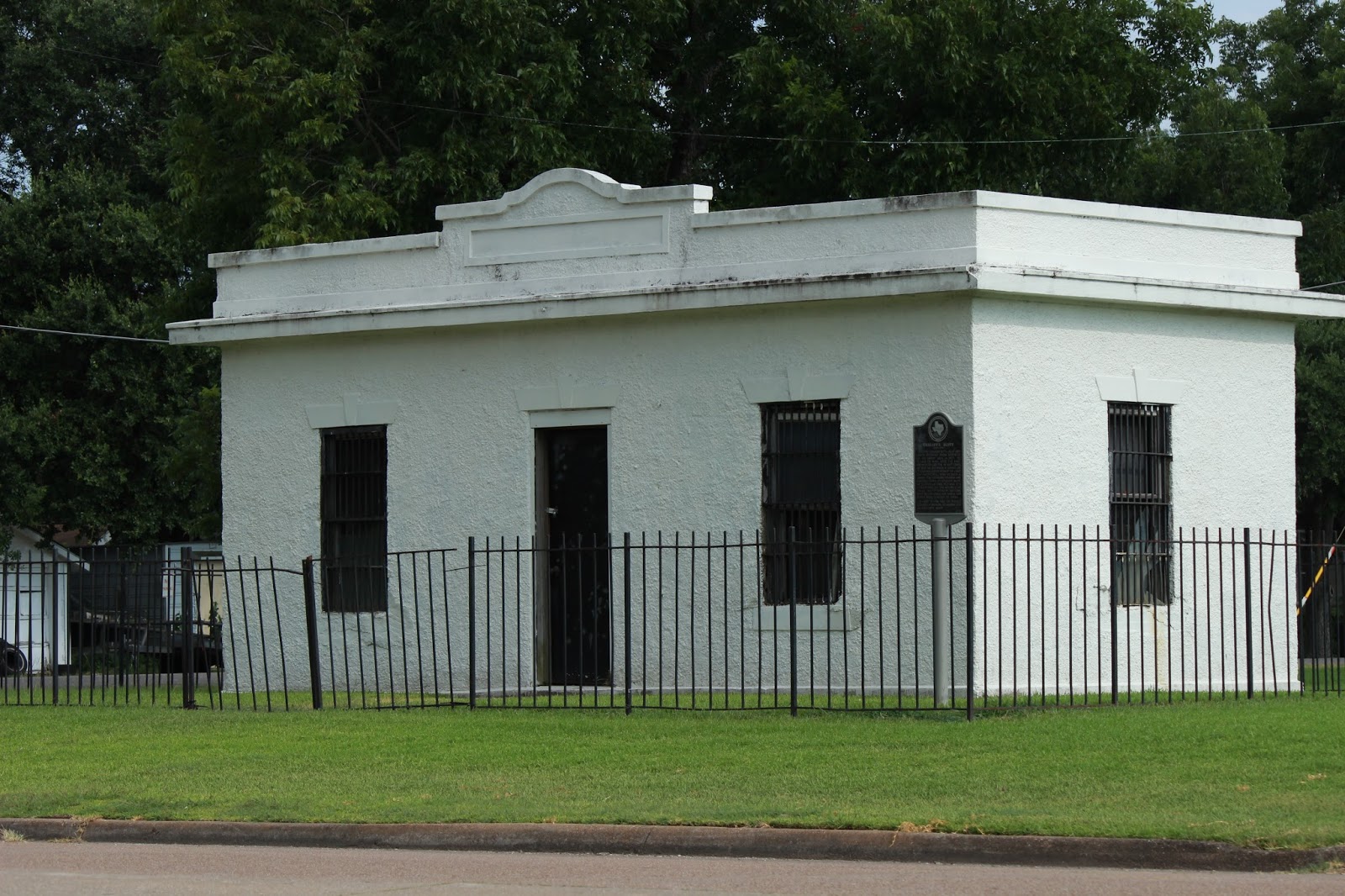
Over in Port Neches (the latter sounds like Tenacious), there’s a tiny building on Grigsby Street with a historical marker out front. This two-cell jail was built during World War I to operate as a branch of the county jail, constructed for the large price of $2,218. If you’d get a good look at this building, that seems high even for today’s standards. What’s even more surprising is its size, appearing like something out of a western comedy with the drunk hanging his hands through the railing and promising to be good.
Across the street in the RiverFrontPark overlooking the Neches River lies the Beausoleil House, or La Maison Beausoleil, an authentic Cajun home (and a fabulous example of early Cajun craftsmanship) built around 1810. The house originated in St. Martin Parish, Louisiana, but was donated to the Les Acadiens du Texas, “a non-profit organization dedicated to the preservation of the culture and language of the Acadian people,” and moved here via by barge. The house is open from 1 p.m. to 5 p.m. on weekends or by special arrangements.
One other great aspect of Port Neches’ RiverFront Park is Tugboat Island, a playground designed by children, built by volunteers, funded by donations and ADA accessible. This baby is huge and wonderfully creative, supposedly the third largest playground of its type in the nation and one sure to make kids squeal with glee.
Beausoleil House
So in the Golden Triangle of Texas, you can visit one of the largest playgrounds in the country next to the one of the smallest jails, enjoy a Pecan Festival in Groves named for trees no longer there but also a person who happened to be named Groves and a historic home that arrived by barge.

Next up on the Weird South blog, we look at the three giant religious monuments in Port Arthur, Texas. You won't want to miss this.

Cheré Coen is an award-winning travel writer specializing in the Deep South. She is the author of "Forest Hill, Louisiana: A Bloom Town History," "Exploring Cajun Country: A Historic Guide to Acadiana" and "Haunted Lafayette, Louisiana" and co-author of "Magic's in the Bag: Creating Spellbinding Gris Gris Bags and Sachets." She also writes Louisiana romances under Cherie Claire, including "A Cajun Dream" and "The Letter." Write her at cherecoen@gmail.com.

Thursday, July 16, 2015

Seeing red at New Orleans Red Dress Run


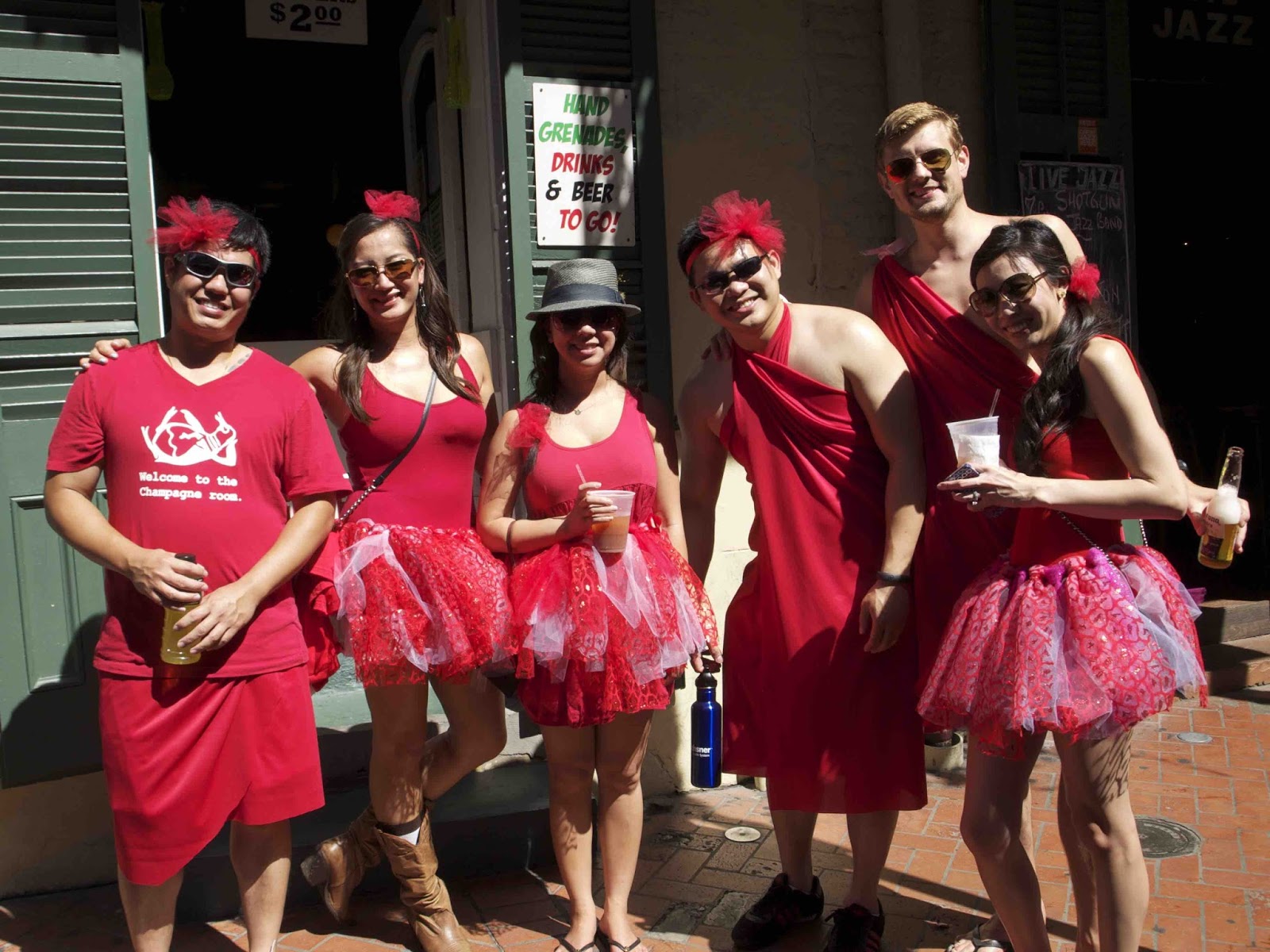
I’d heard about the Red Dress Run for years, a three- to four-mile fundraiser for more than 100 local charities that happens every August in New Orleans. The one caveat is everyone must wear a red dress while they run through the French Quarter.
Nothing prepared me for the onslaught of red and folks running in every type of costume you can imagine. After all, this is New Orleans, the crazier the better!
This year’s Red Dress Run is Saturday, Aug. 8, beginning at 9 a.m. In addition to running in a red dress and raising money, participants receive free beer, food and live entertainment after the event. The event requires runners to be 21 — no exceptions — and to register before the run, either online or the day of the event.
You can register for the Aug. 8 run or for the Hasher registration which also includes the Red Lingerie Run on Friday night, a special area on Saturday, and the Hangover Run on Sunday.
            Check out the web site for more information. For a sneak peek, check out photos below (please remember all photos on this blog are copyrighted by the author). 


Cheré Coen is an award-winning travel writer specializing in the Deep South. She is the author of "Forest Hill, Louisiana: A Bloom Town History," "Exploring Cajun Country: A Historic Guide to Acadiana" and "Haunted Lafayette, Louisiana" and co-author of "Magic's in the Bag: Creating Spellbinding Gris Gris Bags and Sachets." She also writes Louisiana romances under Cherie Claire, including "A Cajun Dream" and "The Letter." Write her at cherecoen@gmail.com.

Tuesday, July 14, 2015

'Mockingbird' alive in Harper Lee's hometown

            There's quite a stir happening today in Monroeville, Alabama, the hometown of Pulitzer Prize-winning author Harper Lee. Walking tours, a marathon reading of To Kill a Mockingbird, storytelling and the release of Lee's latest book, Go Set a Watchman will all happen within the quaint streets of this southern Alabama town. (See schedule below.)
            Stick around for on Wednesday, July 15, 2015, the Monroe County Heritage Museum will host its annual program, Scenes and Stories of Monroeville:  A To Kill a Mockingbird Workshop in the Old Courthouse Museum at 31 N. Alabama Avenue from 9 a.m. to noon, discussing growing up with Harper Lee and race relations in the 1930s. Admission is free to the public and SARIC credit awarded to teachers. Seating is limited and pre-registration is recommended; contact Wanda Green at the Monroe County Heritage Museum at mchm@frontiernet.net or (251) 575-7433. 

Where it all began
            To glimpse into the history of the award-winning Mockingbird tale and its legendary author, visit Monroeville where you can enter the county courthouse and expect to find Atticus Finch sitting for the defense or hear Tom Robinson’s plea for justice. The 1903 courthouse in the center of town was the basis for both Lee’s famous courthouse scene and the Hollywood set used in the 1962 Oscar-winning film.
            Monroeville is Lee’s hometown and much of her book loosely reflects her personal experiences growing up as well as racial incidences that happened in the area. Lee lived along South Alabama Avenue, next door to the Faulks, cousins of writer Truman Capote, who visited often and considered Monroeville one of the highlights of his youth. Lee and Capote played in her backyard tree house and the child character of  “Dill” in Mockingbird is said to have been based on Capote.
            The courthouse today houses the Monroe County Heritage Museums, offering rotating exhibits, a history of the area and comprehensive displays on both Lee and Capote. Every spring a play version of To Kill a Mockingbird by Christopher Sergel is performed on the courthouse lawn to an audience of about 250. Act I occurs outside in three sets, then moves inside the courthouse for Act II, which is the trial of Tom Robinson. The audience follows, watching the trial as if they are participants. For more information, visit www.tokillamockingbird.com.
            Other literary reasons to visit Monroeville include the Alabama Writers Symposium at Alabama Southern Community College, held in the spring about the same time as the play, and Beehive Coffee & Books, a quaint independent bookstore off the square that features local authors and specialty coffees in a restored 1930s building.
            Visitors can pick up a walking tour that explains Monroeville of the 1930s, when Lee and Capote were children. Many of the historic sites are gone, including both authors’ childhood homes, but there are still sites to take in, such as the Monroe County Library, once the LaSalle Hotel where Gregory Park stayed gathering information for his character of Atticus Finch.
             For information on Monroeville, visit www.monroecountyal.com.

Did you know?
            Monroe County, Alabama, exists along the historic El Camino corridor that eventually heads to Natchez, Miss., and on over to Natchitoches and Texas. The county was one of the earliest settlements of Alabama pioneers after the Creek Wars.
            Harper Lee’s father, A.C. Lee, was a lawyer who practiced in Monroeville and a model for her character of Atticus Finch.
            Not only did the courthouse inspire Lee for To Kill a Mockingbird, but the courthouse clock appears in Capote’s A Christmas Memory and The Thanksgiving Visitor.
            Mel’s Dairy Dream now exists where Lee’s house once stood and Capote’s cousin’s home is gone as well. However, pieces of the brick wall surrounding the Faulk home remain, next to a historical marker.
            The film version was adapted by Horton Foote, of which he won an Oscar.
            To Kill a Mockingbird was Lee’s only novel and she has given little publicity since 1964.


Cheré Coen is an award-winning travel writer specializing in the Deep South. She is the author of "Forest Hill, Louisiana: A Bloom Town History," "Exploring Cajun Country: A Historic Guide to Acadiana" and "Haunted Lafayette, Louisiana" and co-author of "Magic's in the Bag: Creating Spellbinding Gris Gris Bags and Sachets." She also writes Louisiana romances under Cherie Claire, including "A Cajun Dream" and "The Letter." Write her at cherecoen@gmail.com.

Friday, July 3, 2015

Taking music underground — or rather underwater: The Lower Keys Underwater Music Festival

            Diving down to enjoy the only living coral barrier reef in the continental United States is reason enough to visit the Florida Keys, but on July 11, 2015, you can do it to music.
            From 10 a.m. to 2 p.m. at Looe Key Reef, an area of the Florida Keys National Marine Sanctuary approximately six miles south of Big Pine Key, the Lower Keys Underwater Music Festival will take place. Staged by Keys radio station WWUS 104.1 FM, music will be piped underwater via Lubell Laboratory speakers suspended beneath boats above the reef. Swimming among colorful tropical fish and coral formations, participants can sway to a sea-focused playlist that typically includes humpback whale songs and melodies like the Beatles' “Yellow Submarine” and Jimmy Buffett's “Fins.”
            The festival began to encourage coral reef protection and environmentally responsible diving. Now in its 31st year, it typically draws several hundred divers and snorkelers annually to enjoy the sound of music along the Keys' reef — the third largest in the world.
            Can’t quite get your mind around this? Check out the video.
Those planning to submerge themselves in the festival can stop by Looe Key Reef Resort, 27340 Overseas Highway on Ramrod Key, between 9 a.m. and 5 p.m. Friday, July 10, for a free dive clinic that consists of buoyancy tests and equipment checks. All divers and snorkelers participating in are encouraged to wear costumes and compete for prizes such as “best dressed.” Some might even pretend to play “underwater instruments” sculpted by Lower Keys artist August Powers, whose creations blend elements of oceanic creatures and whimsical musical instruments.

For more information on the festival or diving the Lower Keys, visit www.lowerkeyschamber.com. For Lower Keys visitor information, visit www.fla-keys.com/lowerkeys or call (305) 872-2411.

Cheré Coen is an award-winning travel writer specializing in the Deep South. She is the author of "Forest Hill, Louisiana: A Bloom Town History," "Exploring Cajun Country: A Historic Guide to Acadiana" and "Haunted Lafayette, Louisiana" and co-author of "Magic's in the Bag: Creating Spellbinding Gris Gris Bags and Sachets." She also writes Louisiana romances under Cherie Claire, including "A Cajun Dream" and "The Letter." Write her at cherecoen@gmail.com.