Showing posts with label weird florida. Show all posts

Wednesday, February 26, 2020

My dog made me do it

Steve Sheridan of St. Louis discovered Port St. Joe and its peninsula Cape San Blas when searching the internet for dog-friendly beaches. Dogs are welcome everywhere in this Panhandle region of Florida, not to mention that the beaches and surrounding forest, lakes and streams are pristine and beautiful.

Sheridan and Ben headed south to the Gulf side of Florida and their life changed.

"He goes everywhere with me," Sheridan said. "He's my co-pilot."

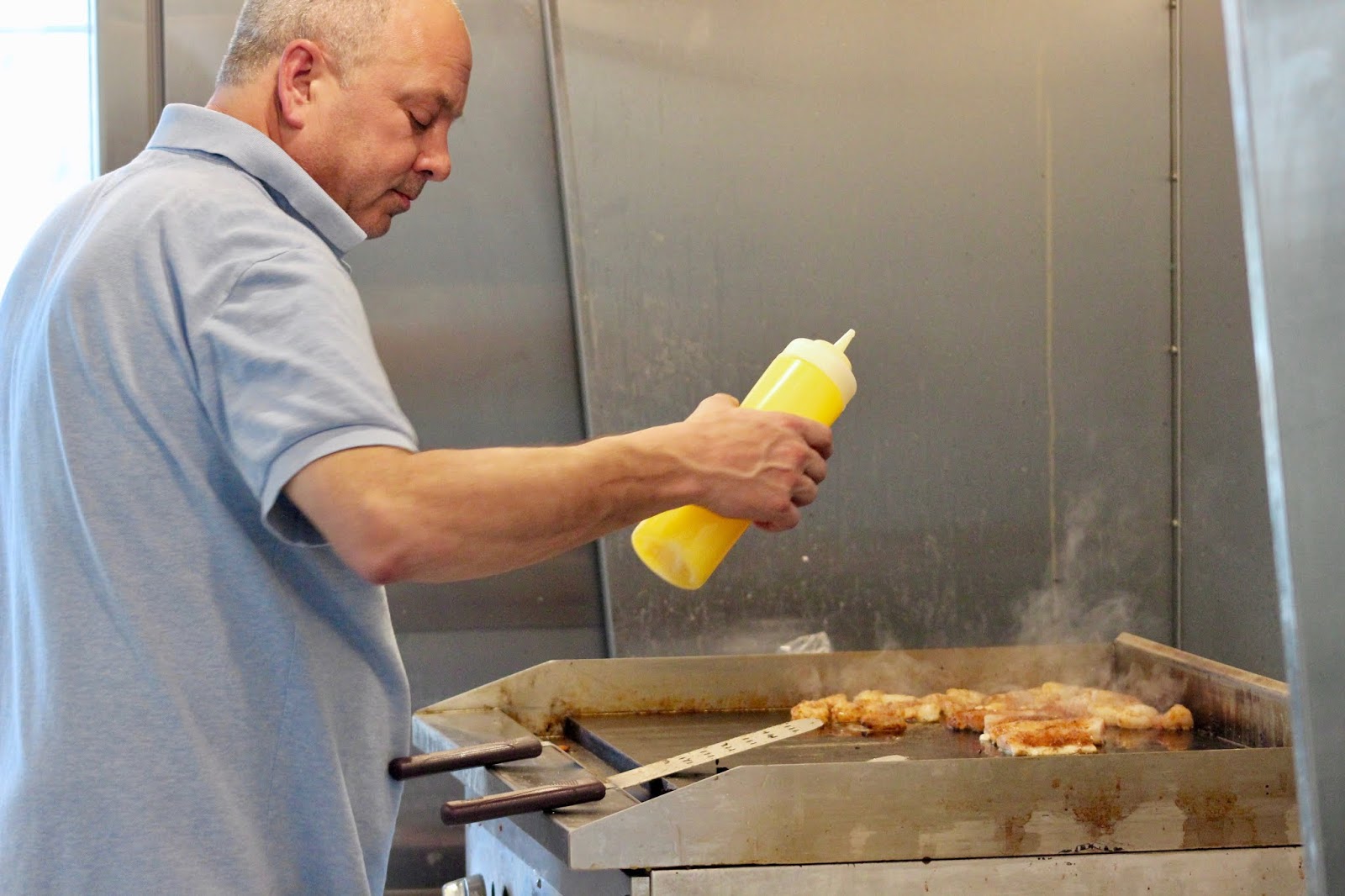
Sheridan worked as a self-employed mechanical engineer so when his wife took a job in Port St. Joe, the move was seamless. But Sheridan wanted to do something different, plus he found the culinary scene on the peninsula lacking. He first opened a food truck, then a restaurant. Today, Peachy's Beach Eats serves grouper sandwiches, nachos, pulled pork and tacos.

Sheridan doesn't take credit cards, however. Diners fill out a form and leave the cash on the counter. If you don't have exact money, take your change from the container.

"I wanted to do something a little different," he said.

Some people are shy about sticking their fingers in the "Change Box" but they get used to it, Sheridan said.

And, of course, Ben hangs out at Peachy's He's almost 13 and half blind but he's as much a part of the ambiance as the upside down beach chairs hanging from the ceiling. And yes, that's me having fun with my iPhone.

Check out Peachy's and be sure to sample the fish and shrimp tacos, a delicious blend of spicy slaw and delicately prepared seafood. Peachy's will also be part of Gulf County Taco Week May 2-8, 2020, in Port St. Joe, where participating restaurants will offer $5 taco specials and chances to win prizes.


Weird, Wacky and Wild South is written by Chere Coen who loves unique restaurants, great tacos and sweet dogs.

Friday, January 3, 2020

Pour your own pancakes at Old Spanish Sugar Mill

They don't just serve great pancakes at the Old Spanish Sugar Mill Grill and Griddle House at DeLeon Springs State Park in central Florida, they make you do it yourself. But that's part of the fun.

Our waiter Jones bringing us the batter.
The mill dates back to the early 1800s when the first structure was built near the springs to crush sugar cane. The mill was destroyed during the Second Seminole War of 1835 and again during the American Civil War but rebuilt around 1900. Peter Schwarze saved the building from destruction in 1961, once again grinding flour utilizing the springs and serving the finished product in a home-style restaurant. The family continues the tradition today.

Customers sit at tables with griddles in the middle and are served two different types of pancake batter made from stone-ground grains. One pitcher contains "early American" batter consisting of unbleached white flour and the other, a homemade mix of buckwheat, rice, rye, corn and whole wheat flour. After the waiter/waitress instructs diners on how to operate the griddle, the final product is up to them. Diners can make plain pancakes or add ingredients such as banana slices, blueberries, chocolate chips or real peanut butter, among many others. Once the pancake begins to bubble, diners must flip them, let them become nice and crispy, then enjoy, topped with real maple syrup, local honey or a flavored syrup.

Pancakes aren't your thing? Those griddles can also be used for cooking eggs and French toast. Meat is prepared in the kitchen and delivered to the table. And for those with gluten intolerances, vegan pancakes are available.

I have to admit, it was pretty darn fun pouring our own pancakes and the blueberries we ordered made for some nice happy faces.

DeLeon Springs State Park in DeLeon Springs of West Volusia County, Florida, centers around a springs that delivers crystal clear waters at 72 degrees year round and manatees that love to visit in the winter. No one knows if explorer Ponce De Leon visited the springs or if they were indeed the Fountain of Youth but the Timucuan Native Americans lived here and called the springs Acuera or "Healing Waters." Naturalist John James Audubon visited the springs in 1831 and a resort existed by its shores for many years. Today, in addition to pancakes, visitors can enjoy swimming, boat tours and hiking.
Want to see how it's done? Check out Georgia Turner, the executive director of the West Volusia Tourism Advertising Authority, showing me how to pour pancakes here.

Friday, September 6, 2019

Obelisk marks freedom, compassion, history in St. Augustine


There’s lots to love about the St.Francis Inn in St. Augustine, Florida, a 1791 landmark in the oldest city in America with centuries of history within its walls, including a ghost tale or two. On the way back from town an odd statue caught my eye in the St. Francis Park across from the Inn, an obelisk covered in small photos of people. There’s a story behind this unusual landmark situated in a city park, and it connects to both the city’s Spanish heritage and the St. Francis Inn.
            At one time the Inn was owned by Col. Thomas Henry Dummett of Barbados, an officer in the British marines. He fled an insurrection in Barbados, arriving in St. Augustine and buying the property in 1842. Two of his daughters married military men who fought for the South in the Civil War. His other daughter, Anna, never married and later converted the home into a lodging establishment. A supporter of the Confederacy, Anna longed to honor those who fought for the South, so she raised money for an obelisk to be installed in St. Augustine’s central plaza. It remains there to this day.
            But that’s not the only obelisk in town. In fact, Anna’s obelisk was patterned after another.
The 30-foot Monumento de la ConstituciĂ³n obelisk was erected in 1813 when St. Augustine was the capital of the Spanish colony of Florida. The monument aimed to highlight the new constitutional government of Spain at that time and its focus on freedom, democracy, human rights and compassion. When the constitutional government in Spain was overthrown, these colonial monuments were ordered to be destroyed but St. Augustine resisted and the obelisk inside La Plaza de la ConstituciĂ³n is believed to be “the only surviving, unaltered monument in the world from this campaign,” according to a city historical marker. It was placed on the National Register of Historic Places in 2012.
Jump ahead to 2015 when celebrations began for St. Augustine’s 450th anniversary. Twenty-five artists were selected to created artwork on individual 8.5-foot obelisks, replicas of the Monumento de la ConstituciĂ³n. Artists were asked to interpret the values attached to the original monument — freedom, democracy, human rights and compassion. Collectively, the obelisks created a “Tour of Compassion” from Compassionate St. Augustine Obelisk 450 during the anniversary celebration from October 2015 to February 2016.
            One of the oblelisks was created by Leslie Robinson and featured photos of locals holding miniature obelisks. It’s now located inside St. Francis Park opposite the St.Francis Inn.
            “I hope to concentrate on the ideals of freedom, democracy, human rights and compassion by focusing on the individuals who make up St. Augustine’s community,” said Robinson in the artist’s statement. “While public monuments are erected to mark momentous events in history, it is individuals, and not official histories, who make daily progress toward positive change.
            “By posing with a model of the Monumento de la ConstituciĂ³n, individuals accept the freedom to create their own relationship to history. The obelisk stands as a record of those individual moments.
            “Governments mandate civil rights only after the will of the people push these ideals forward, and change will always be instigated by individuals moved by compassion and the will to seek a better future. We are history. History is ours to make.”
            Click here to view more about Obelisk Art 450.
Weird, Wacky and Wild South is written by food and travel writer Chere Dastugue Coen, who loves unusual history. 

Wednesday, May 31, 2017

Ziplining a life experience. Who knew?

Our brave group of travel writers.
There’s something terrifying about climbing high above treetops and jumping off. It’s not the worry about falling to my death. Because I understand that two levels of ziplining cables, the trolleys and the double carabiners will protect me. What I feared most was having to brake myself at the other end.

My first ziplining experience was in North Carolina where a group of us zipped through several lines as snow softly fell. It was both exhilarating and horrifying, because as much as I enjoyed flying through the winter air and viewing the gorgeous mountain scenery I kept spinning and forgetting how to brake at the other end. The guides assured me they would catch me if I failed, but the first time I screwed up my brake and rammed into the guy. Which was enough to scare anyone off the sport.
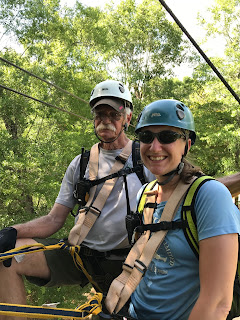
Bill and Erin, our trusted guides

Later, I would zipline without the need to self-brake and loved that so much better. I started gaining confidence and would gladly raise my hand when the offer to zipline emerged.

Until last month. 

A group of travel writers — me included — were invited to zip through the canopy of Adventures Unlimited near Milton, Florida, in Santa Rosa County, an attraction that also offers cabin accommodations and paddling down Coldwater Creek, one of the most pristine waterways in the state — and one that I highly recommend enjoying. As we walked to our first run, I was told that self-braking was in store, but no worries, they would explain and all would be fine. Guess what? After listening intently to the instructions, I stuck my hand in front of the trolley to brake — it goes behind — and screwed up my brake on the first run. I ended up stumbling horribly, then stopping before the platform, having to turn and pull myself in.

Are you kidding me?
“I don’t worry about you,” our guide Bill told me. “I can tell you have no fear so you’ll be fine.”

Was he blind?

Our next run was a LONG climb up, so my second attempt was frighteningly high, as in seeing magnolia blooms at the TOP of trees. I couldn’t imagine stepping off that platform. I asked to go last — as if that would help. And then I stood there like a zombie, staring off into the trees hiding the next platform where Bill waited, a man who believed I had no fear.

“You can do it,” said Erin, the other guide who waited patiently behind me.

“No, I can’t,” I thought, but I walked off anyway, flying through the air like a fool but not spinning and remembering to brake the cable above my head, but this time behind me. I actually slowed the dang thing down and slipped into my guide’s arms without a problem. I don’t know who was more excited, that man or me.

Me finally learning to zip.
It took a few more attempts before I felt confident, but by the seventh run, a long, delicious stretch that veers over Coldwater Creek, I actually enjoyed the run, stopped thinking too much about my braking and started relishing the scenery. As we walked back to the outpost with our gear beating against our legs and our bandanas glued to our humid foreheads, I was a new woman.

I came. I ziplined. I braked!

Want to see Bill easily flying over Coldwater Creek? Click here for my Facebook post.
  

For more information on Adventures Unlimited, visit http://www.adventuresunlimited.com/. Be sure and stay the night, enjoy the cabins and paddle the that gorgeous creek.


Coldwater Creek at Adventures Unlimited

We're actually happy at the end. We did it!
CherĂ© Dastugue Coen is a travel and food writer from South Louisiana who appreciates the weird and wild side of life. She actually ziplined over alligators near Shreveport (read about it here), but the braking there was easier. Write to her at cherecoen@gmail.com.