Showing posts with label natchez. Show all posts

Monday, November 13, 2017

Visiting Angels on the Bluff in Natchez

Tickets go on sale every year on Aug. 1 for the annual Angels on the Bluff, the long-running candlelit tour of the Natchez City Cemetery. And folks in the know have this date circled on their calendar. Tickets sell out quickly and it’s easy to understand why. Local actors and musicians in period costumes channel historical figures from beyond the grave — and the town has its fair share of colorful people who have passed.  

Robert Stewart
I was honored to have been a part of this year’s celebration, held Nov. 9-11, 2017. There were 16 shuttles the evening I participated, meaning 16 busloads of ticket holders being shuttled from the Natchez Visitor’s Center to the cemetery on the north side of town. All proceeds benefit the cemetery.

We were the 6 p.m. group and we filled the school bus to capacity. Once at the cemetery, we followed our leader dressed in a jacket with reflector tape and holding a flashlight. The trails we were meant to follow were lighted by luminaries and several of the live oak trees were lighted from below, casting eerie shadows about. Some of the angels atop gravestones, including the famous “Turning Angel,” (more about her later), were also illuminated and stood out in the darkness as if serving as our protector.

Lilly Granderson
First up to tell her story was Katherine Grafton Miller, the founder of the Natchez Pilgrimage, who described how she saved the town with tourism in the 1930s. We then met cabinetmaker Robert Stewart who once also served as one of the city’s undertakers.

L.S. Cornwell, a local merchant and brief publisher of The Eagle newspaper in Concordia Parish, Louisiana, was played by an Angels veteran, a humorous actor accompanied by the dead man’s wife, who also gave a humorous tone to the storytelling.

Lilly Ann Eliza Granderson was an inspiring story, telling how she rose from house and field slave to a woman who operated a secret school where she taught other slaves to read and write.

Many people know of Florence Irene Ford because of her unusual grave. Florence’s mother comforted her in life when thunderstorms hit — she was deathly afraid of them — so when she died at the young age of 10, her mother built a stairway into the ground and a window next to her coffin so that she may visit Florence and comfort her when storms arrived.
The Turning Angel

Back to the Turning Angel. One of the night’s storyteller was John Carkeet, a plasterer and undertaker who was the 11th victim of the 1908 Natchez Drug Company Explosion. The downtown building exploded and burned due to a gas leak and five young women were among the casualties. Their bodies are buried beneath the Turning Angel and the angel watches over them. It’s said that when you walk near the statue, the angel’s eyes will turn and follow you.

Greg Iles, a New York Times bestselling author who lives in Natchez, once used her image on the cover of one of his books, appropriately titled "Turning Angels."

Other fun aspects of the night included a fiddler at a Civil War soldier gravesite, reliving the dancing life of Lillie Vidal Davis Boatner and a dance around a campfire by gypsies.


Sound interesting? Mark your calendar for Aug. 1 and nab those tickets fast. For more information on this historic and beautiful cemetery, visit https://www.natchez.ms.us/150/Cemetery.

Tuesday, June 13, 2017

The Natchez Bridge of Sighs and its magnificent view

The Mississippi River as seen from the Natchez Bluffs
I was born and reared on the side of the Mississippi River so it holds a special place in my heart. Many’s the time I spotted ships moving past higher than my head when the river rose in the spring and there was only a levee between my New Orleans home and those muddy waters. Later, I would work along the river in Baton Rouge and never fail to pause and admire the third largest river in the world.

But it was those levees that kept that river from me. When you visit towns such as Natchez, Mississippi, a city built upon a bluff, the river stretches before you like a goddess. My favorite activity when visiting Natchez is to stand beside my river and absorb that magnificent view along the Natchez Bluff.


All along the riverfront in Natchez is a walking-biking trail, one high upon the bluff, and one closest to the river’s edge. In 2015, to connect the two sections of the bluff-side Spanish Esplanade or Promenade, the city of Natchez built the “Bridge of Sighs,” a footbridge allowing pedestrian traffic over Roth’s Hill Road. The recent addition is a replica of a 19th century bridge that spanned Roth Hill Road, and that bridge got its name from an ancient one in Venice, Italy.

Walking across the Natchez Bridge of Sighs, visitors will spot numerous padlocks, some sporting initials and names, a tradition that lovers use as a public token of their affection. Placing padlocks on bridges is popular in Europe, including Italy.

The Bridge of Sighs in Venice, by the way, was built to connect the city’s New Prison to the interrogation rooms within the Doge's Palace. It was the last view of Venice convicts saw before their imprisonment. There are similarly named bridges in Cambridge, England; Stockholm, Sweden; Glasgow, Scotland; at The Venetian in Las Vegas; connecting The Tombs with the Criminal Courts Building in New York City; and within the Santa Barbara County Courthouse in California. Richard Russo wrote a novel titled “Bridge of Sighs” and the bridge has been used in operas as well as the title song of Robin Trower’s album, ”Bridge of Sighs.”

And I’m not the only one who fell in love with the Natchez bluff, although I didn’t leave a padlock behind. Frederick Law Olmsted, known as founder of landscape architecture in America, said this: “But the grand feature of Natchez is the bluff, terminating in an abrupt precipice over the river, with the public garden upon it…. So, after supper, I went to the bluff again, and found it most solemnly beautiful; the young moon shining through rents in the clouds: the great gleaming crescent of water; the dim, ungapped horizon; the earth sensibly a mere swinging globe.”

Perhaps Olmsted would have left a padlock behind as well.

Cheré Coen is a food and travel writer who loves weird and unusual things, and hopes the owners of these padlocks truly find everlasting love.

Monday, March 14, 2016

Natchez Mammy


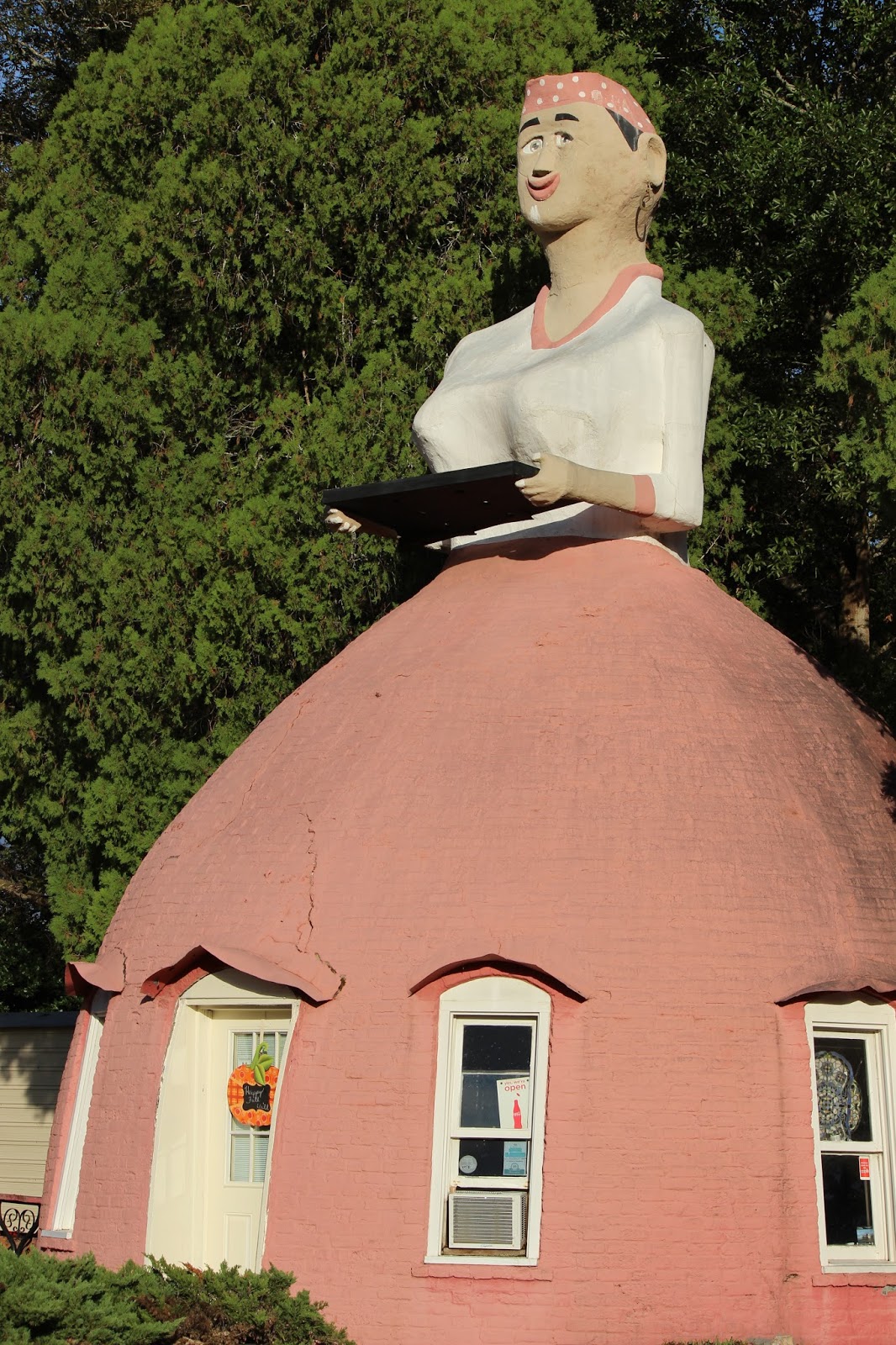
Driving up to Natchez, Mississippi, there’s a roadside attraction along Highway 61 that will make you stop and exclaim, “What?”
It’s Mammy’s Cupboard and the restaurant is built in the shape of an Aunt Jemina-type character, a homage to the nourishing servant made popular in “Gone With the Wind.” The eating area exists within the skirt of an African American servant with the smiling woman’s head resting on top, holding a serving tray. The entire structure is 28 feet tall, enough to make drivers pull over out of curiosity, but leaves only a small space inside.
The restaurant, known to serve delicious lunches and desserts, was built in 1940 during non-political correctness days, meant to encourage people to stop for a bite as they headed over to Natchez and the numerous antebellum homes, not to mention the annual Natchez Pilgrimages in the spring and fall. Later, when PC was coming into vogue and Natchez visitors didn’t quite appreciate the sentiment, the mammy’s skin color was lightened. Today, she could be any race.
            Lots of famous people have graced Mammy’s skirts and the restaurant has become one of the most photographed spots in Mississippi.